Overview
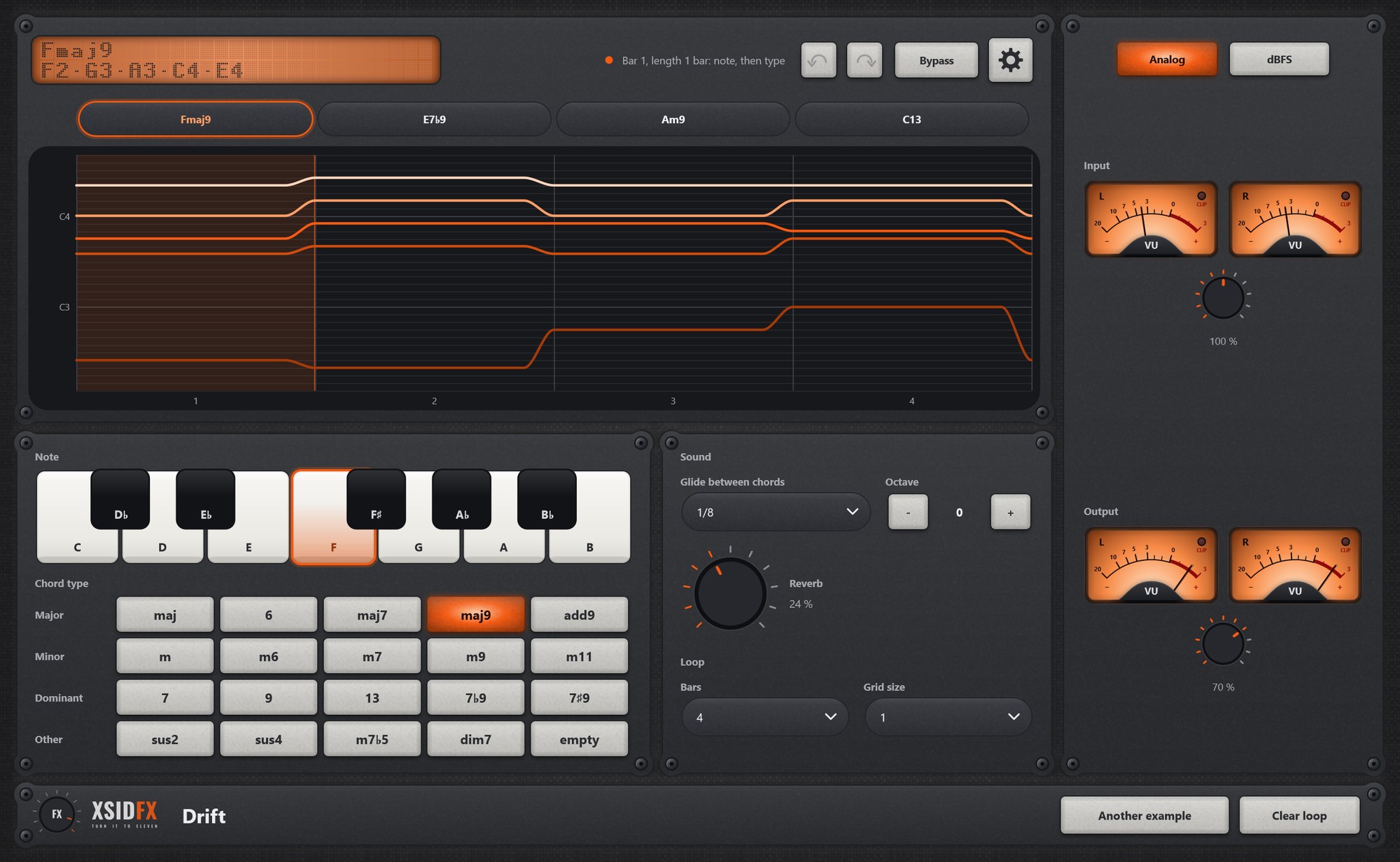
Drift plays a loop of chords in time with your DAW. Its five voices do not jump from one chord to the next: each glides to the nearest note of the next chord along a smooth curve, so the harmony drifts rather than steps. The movement is drawn as it happens, a line for each voice from the bass up.
The sound comes from Drift’s own oscillators, or from the audio coming into it, pitch-shifted to the chords. It follows the DAW’s transport: it plays when the song plays, and moving or looping the playhead puts the voices exactly where they belong.
Getting started
- Start the DAW’s transport: the example loop (Fmaj9, E7b9, Am9, C13) plays.
- Click a chord in the row above the lines to choose it, then pick a note and a chord type below.
- Set Bars and Grid size for the loop’s length and how finely it is divided; Glide sets how long the voices take to move.
Controls
| Chord row | The loop’s chords in order. Click one to choose it; the lines under it show where every voice is. |
| Note | The chord’s root, on a piano octave. |
| Chord type | Major (maj, 6, maj7, maj9, add9), Minor (m, m6, m7, m9, m11), Dominant (7, 9, 13, 7b9, 7#9) and Other (sus2, sus4, m7b5, dim7, empty for a rest). |
| Glide between chords | How long the voices take to slide to the next chord, in note values. |
| Octave | Moves the whole loop up or down by octaves. |
| Reverb | How much of Drift’s own reverb is added. |
| Bars, Grid size | The loop’s length and the size of one cell of the grid the chords sit on. |
| Another example | Loads another example loop. |
| Clear loop | Empties the loop to start your own. |
Settings
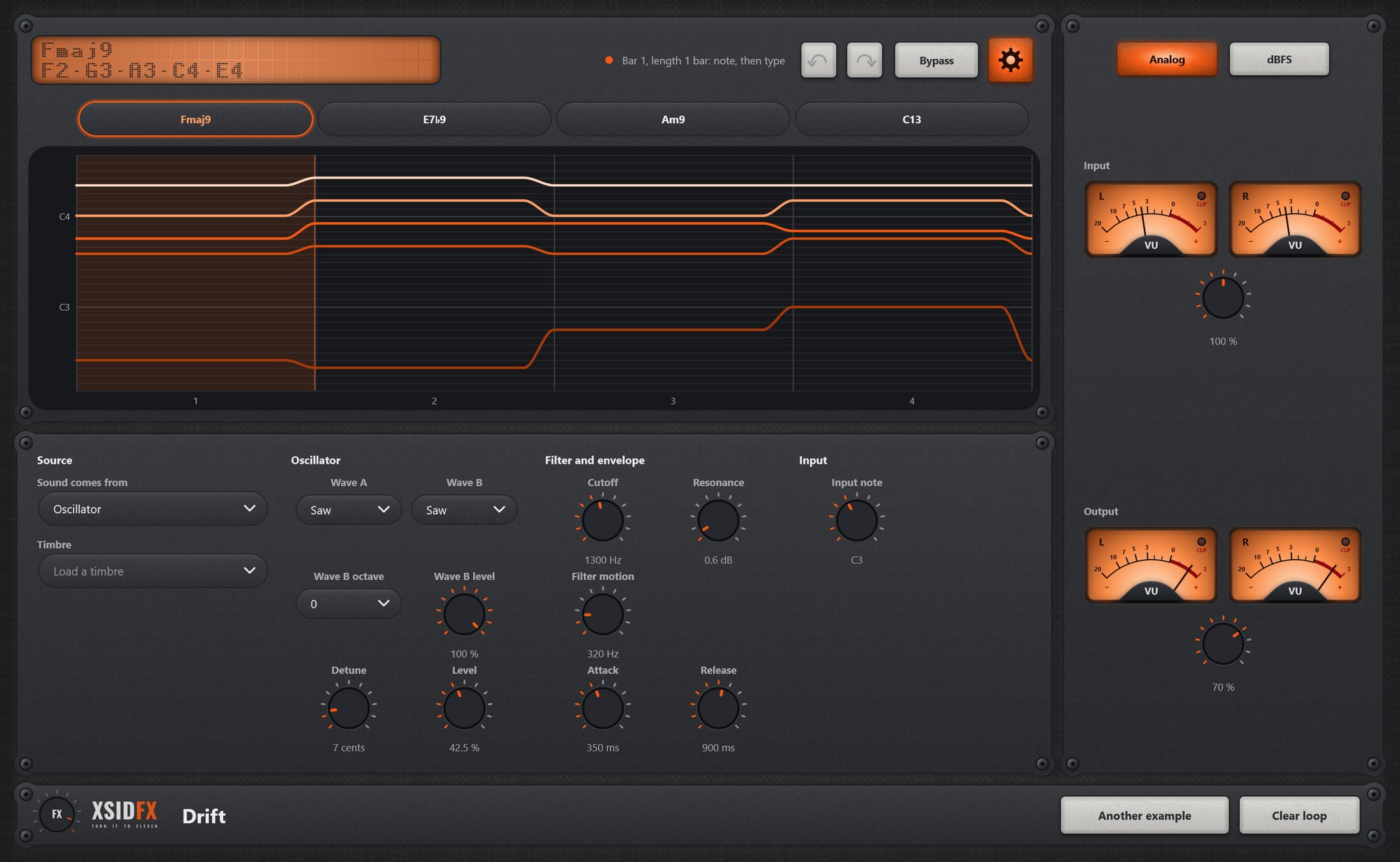
The gear in the header opens the settings panel; it covers the lower panel until the gear is clicked again.
| Sound comes from | Oscillator, or Input: pitch shift, which plays the incoming audio at the chord’s notes. |
| Timbre | Loads one of the ready sounds: Warm pad, Choir, Organ, Saw. |
| Wave A, Wave B | The two oscillators’ shapes: Saw, Square, Triangle, Sine, Organ. Wave B has its own octave and level. |
| Detune, Level | How far the two waves are apart in cents, and the overall level. |
| Cutoff, Resonance | The low-pass filter over the voices. |
| Filter motion | How far a slow LFO moves the cutoff. |
| Attack, Release | How the voices swell in and fade out. |
| Input note | With the input as the source, the note the incoming audio plays (MIDI to Drift sets it too). |
What the screen shows
The lines show each voice’s pitch over the loop, from the bass (darkest) to the top voice (lightest); the chosen bar is lit. The header shows the chosen chord and its five notes.
Tips
- Leave the transport stopped and click a chord to hear it on its own for a moment.
- Use ’empty’ as a chord type to leave a gap in the loop.
- As the voices always move to the nearest note, chords a fifth apart give the smoothest drift.
Technical notes
- Instrument; follows the host’s tempo and transport.
- The voices’ pitch is worked out from the position in the song, so seeking and looping never put them out of place.
Common to every plugin
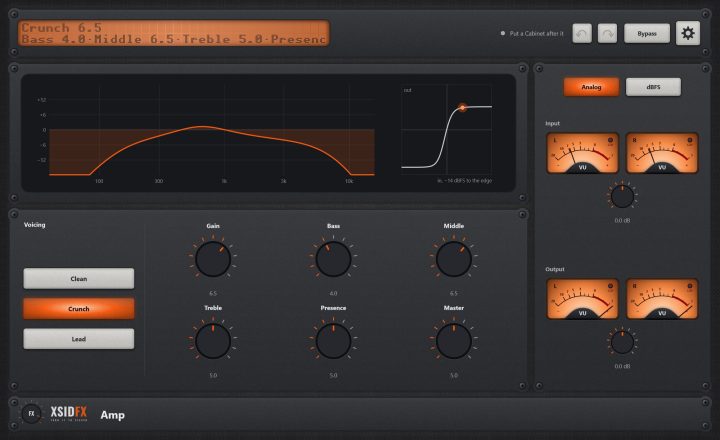
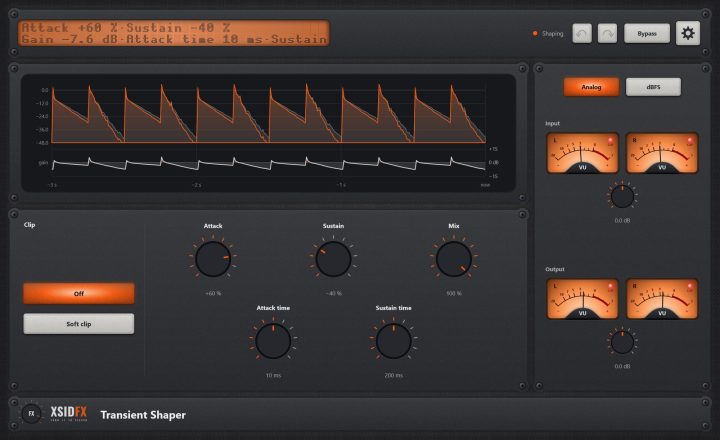
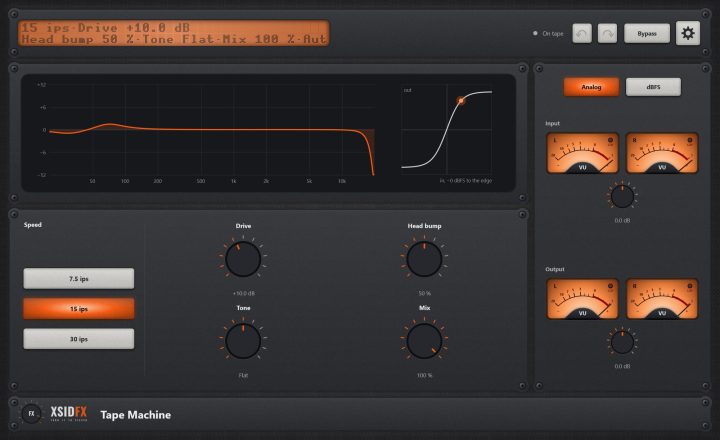
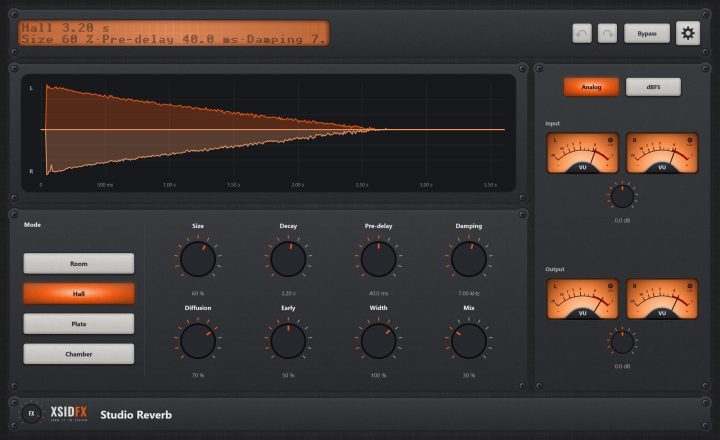
| The header | Every window opens with the same header. On the left a dot-matrix display shows the main reading large and the details under it; text that does not fit scrolls. Next to it a hint with a coloured dot says what the plugin is doing or what to do next. On the right: Undo and Redo arrows (up to 100 steps of everything done in the window), the Bypass button, and the gear, which opens the plugin's settings panel when it has one. |
| Bypass | With Bypass lit, the plugin lets the sound through untouched. It is the same switch as your DAW's own bypass for the plugin, so either can be used and automated. The input is held back by exactly the plugin's latency, so the timing stays right, and switching fades over 10 ms, so it never clicks. Bypass is not part of Undo. |
| Input and Output | Most plugins have a column on the right with a pair of VU meters for the input and the output, each with its own gain knob (plus or minus 24 dB). Analog shows the classic VU scale, dBFS the digital one. A click on a meter opens a large view of it. The CLIP lamp lights when a sample reaches 0 dBFS. |
| Knobs | Drag a knob up or down to turn it. Knobs that go both ways, or that have a natural middle, catch briefly at their centre. A double-click returns a knob to its default. |
| About and the demo | A click on the xsidfx logo in the footer opens About. In the demo version the plugin's name ends in (demo), its settings are not saved with your project, and About opens each time the window does. |